Join NDIF's bi-weekly reading group on meta-learning and cognition in AI models!Calendar →

Cracking open
AI's black box

The NSF National Deep Inference Fabric (NDIF) provides free remote access to large-scale AI models, democratizing access to model internals for transparent and reproducible experimentation.

Supported by

National Science Foundation
NAIRR
Northeastern University
NCSA
PIT-UN
0+
Research Papers Using our Tools
0+
Ecosystem Repos Built on NNsight
0+
GitHub Stars Across NDIF-Team Repos
0
GPUs for Remote NDIF Execution

Data sourced from NDIF internal metrics and public GitHub repository statistics.

What is NDIF?

The National Deep Inference Fabric is a unique nationwide research computing fabric that enables scientists to perform transparent and reproducible experiments on the largest-scale open AI systems. NDIF has three parts:

HPC Fabric

A nationwide high-performance computing fabric powered by NCSA's Delta — utilizing one 8xH200 node and six 4xA40 nodes — providing free remote access to run experiments on large-scale AI models.

NNsight Library

An open-source PyTorch-based toolkit (1100+ GitHub stars) that lets researchers inspect, modify, and customize internal computations of AI models, complete with remote access to large scale models.

Training Program

A nationwide training program developed with PIT-UN, a consortium of 63 universities and colleges, providing workshops, tutorials, and resources to build a broad community of AI researchers.

Remote Model Access

Access and inspect open-source model internals remotely on NDIF with the NNsight API. Deploy models on-demand with full transparency into their computations.

All models are free for research use — no GPU required on your end.

Hot70B

Llama 3.1 70B

meta-llama/Llama-3.1-70B

Hot8B

Llama 3.1 8B

meta-llama/Llama-3.1-8B

Warm405B

Llama 3.1 405B

meta-llama/Llama-3.1-405B

Warm120B

GPT-OSS 120B

openai/gpt-oss-120b

Featured Research

Researchers worldwide use NDIF and NNsight to uncover how large-scale AI models work, with 140+ published papers at top venues including ICLR, NeurIPS, ICML, and EMNLP.

A Pre-Specified Construction-Confirmation Test of Operation-Level Causal Transfer Across Finite Isomorphic Symbolic Domains
ArXiv 2026

A Pre-Specified Construction-Confirmation Test of Operation-Level Causal Transfer Across Finite Isomorphic Symbolic Domains

Xinyi Shan

The paper investigates whether a language model can transfer operational knowledge between symbolic domains by applying input-specific adjustments to its internal states. It tests a precise intervention: estimating how the model’s hidden state changes when performing an operation in one domain (like successor in integers mod 16), then applying that same change to a corresponding input in another domain (like letters) to see if it produces the correct output (predecessor). Using careful controls and a two-stage validation process — first identifying a promising candidate, then confirming it on independent data — the authors find that one specific route (integer mod 16 to letters, successor to predecessor) consistently works across two different intervention tools on a single model and layer range. While this suggests the model encodes some operation-level structure that can be transferred in this narrow case, the result is highly specific and does not imply broader capabilities like generalizing across models, domains, or operations. The work advances understanding of how symbolic reasoning might be localized and manipulated in neural

A Unifying Perspective on Language Model Representations: From Filler-Role Structure to Mechanistic Interpretability
ArXiv 2026

A Unifying Perspective on Language Model Representations: From Filler-Role Structure to Mechanistic Interpretability

Zhang Enyan, R. Thomas McCoy

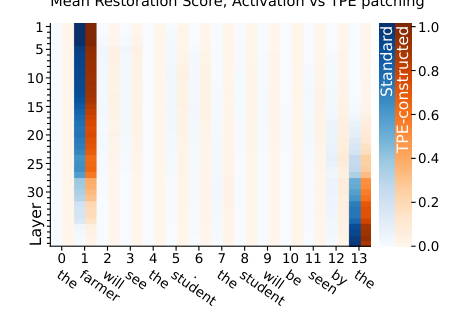
This work introduces Tensor Product Representations (TPRs) as a unifying framework for understanding how language models encode compositional structure in their internal representations. By modeling meaning as bindings between "fillers" (content) and "roles" (structural positions), TPRs provide a mathematical foundation that explains why diverse interpretability techniques — such as analogical reasoning, probing, sparse autoencoders, and activation patching — often reveal related patterns. The authors demonstrate both theoretically and through experiments across model scales that these methods can be seen as special cases of TPR-based analysis, suggesting a deeper, shared structure underlying model behavior. This approach moves interpretability beyond isolated observations toward a coherent account of how neural networks represent and manipulate structured knowledge.

Activation Probes Surface Code-Security Signals that the Model's Output Misses
TAIGR workshop, ICML 2026

Activation Probes Surface Code-Security Signals that the Model's Output Misses

Ivan Wiryadi

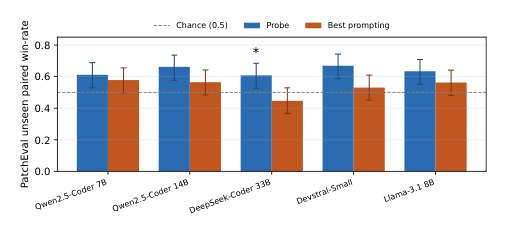
Researchers investigated whether the internal activations of open-weight AI models could detect security flaws in code more effectively than simply asking the model to judge code safety through prompts. They trained a lightweight probe on pairs of vulnerable and fixed Python functions, then tested it on real-world vulnerabilities the model had never seen during training. Across multiple models, the probe consistently identified the vulnerable version of a function as higher risk than its fixed counterpart, outperforming random guessing and surpassing the model’s own prompted judgments — even when those prompts included chain-of-thought reasoning. This suggests that the model’s internal representations contain usable security signals that are not accessible through standard prompting, offering a promising path for scalable code review in AI-assisted development.

Get Started in Minutes

Three simple steps to start running experiments on large-scale AI models.

01

Install NNsight

Install the open-source NNsight library with a single pip command.

$ pip install nnsight
02

Sign Up for Access

Create a free account to get remote access to large-scale models hosted on NDIF.

03

Start Experimenting

Run transparent, reproducible experiments on model internals — no GPU required.

$ model.trace(remote=True)

Join the NDIF Community

We'd love to have you. Whether you're debugging your first experiment or contributing to the codebase, there's a place for you here.

Join the Conversation

Got a question? Stuck on an experiment? Our Discord is where researchers share ideas, get unstuck, and geek out about model internals.

1,200+ members

Join Discord

Hands-On Workshops

Learn by doing. We run regular workshops that take you from zero to running your first remote experiment on large-scale models.

Free for researchers

See Upcoming Events

Contribute to NNsight

NNsight is open source and built by researchers like you. Whether it's code, documentation, or a bug report—every contribution helps.

850+ stars

Explore on GitHub